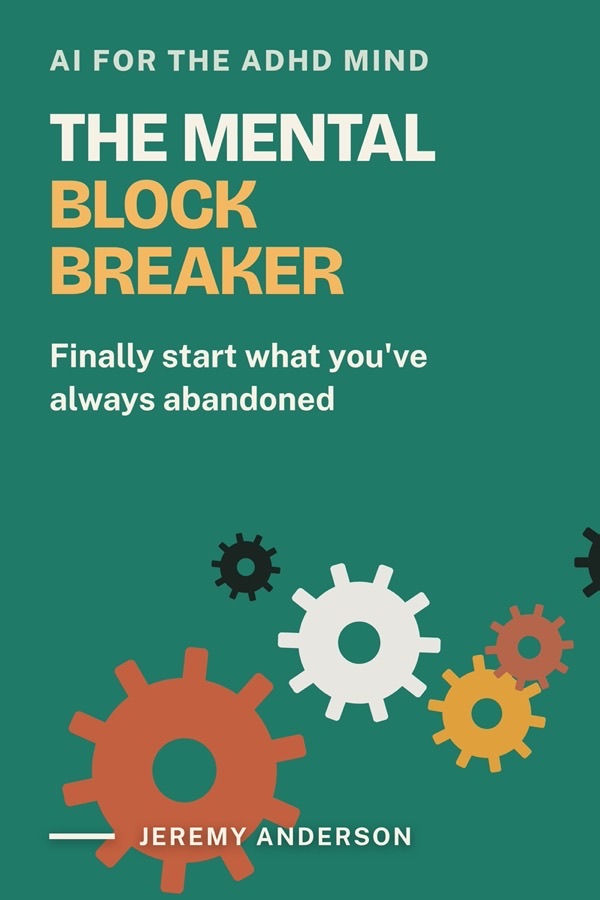
The opening pages of AI for the ADHD Mind: The Mental Block Breaker, by Jeremy Anderson, reproduced in full and exactly as they appear in the book.
Introduction: What Changed
I'm not a clinician. I'm not an ADHD researcher. I'm just a normal guy who's lived with this problem my entire life.
This book wasn't written just to share my story. It was written specifically to help my adult children, all of whom struggle with elements of what this book addresses in different ways and degrees. I wanted to give them something practical they could use: an example of what's possible when you have the tools and know how to manage them.
If this helps you too, I'm grateful. And I want to be clear: this isn't meant to replace the resources, strategies, and support systems that already exist. If something's already working for you, keep using it. This book is meant to augment what you're already doing, or to offer another option if you haven't found something that works yet. This is simply what I've discovered works for me, and I wanted to share it.
My life has been filled with incomplete tasks. Hundreds of ideas that I never finished. Not because they weren't good. Not because I didn't want them to succeed. For years, I thought something was wrong with me: that I lacked discipline, wasn't committed enough, wasn't the type to finish anything.
Then I started using AI. And something shifted.
I immediately saw what was happening. AI wasn't solving where ADHD creates friction. It wasn't changing how my brain works. But it was filling a specific gap I'd felt my entire life: the gap between idea and execution. Between knowing what to do and actually doing it. Between starting and finishing.
Suddenly, I started completing things. Projects I would have otherwise abandoned. Ideas that became real. Work that moved forward instead of stalling.
And I realized: if AI can fill this gap for me, it can fill it for anyone else dealing with the same thing.
A quick note: This book isn't about advanced AI prompting techniques or engineering the perfect query. If you've used AI before, you might recognize some of these ideas. This is an introduction to using AI as a partner for the specific gaps where ADHD creates friction. It's written for people new to AI, or new to using it this way. You don't need to be an expert. You just need to be willing to try.
How to Use This Book
This isn't a how-to guide for using AI platforms. Plenty of resources exist for that. What this book does is show you how AI fills the gaps where ADHD creates friction: the specific blocks that show up between intention and completion.
Each chapter addresses one of those blocks. Paralysis shows up both as not knowing where to start and as hitting an invisible step once you're already moving, and distraction shows up both as what pulls you from the outside and what your own mind generates from the inside. Same block, two faces, one system for each. And nearly every chapter includes an exercise designed for you to practice immediately. This isn't meant to be read passively. It's meant to be lived. You'll work through problems in real time as you read.
Throughout this book, I use AI in a platform-agnostic way. The skills and frameworks I teach work regardless of which platform you choose, whether it's Claude (which is what I personally use), ChatGPT, Gemini, or any other AI tool. The terminology might differ between platforms, and the specific features might vary, but the underlying approach is the same.
To get the most out of this book, you'll need a free account with at least one of these platforms. If you ever have questions about how to do something specific on your platform of choice, check Appendix A. It covers tool setup, free vs. paid options, and where to find more detailed how-to guides for different platforms.
What you're about to learn isn't theoretical. It's lived. By the end of this book, you'll understand how AI works as an external cognitive partner, something that catches you at the exact moment you're about to quit and shows you the next step.
The gap is real. The solution is real. And it works.